
Child-first design starts with a simple premise: a pediatric space should work for a child’s body, nervous system, and sense of safety, not just look “kid-friendly.” When design reduces stress and supports self-regulation, children can cope better with unfamiliar procedures, and caregivers can focus on listening, asking questions, and making decisions. Evidence-based healthcare design links better experiences and outcomes to environments that support control, social support, and positive distraction (Ulrich, 2000; Ulrich et al., 2008).
This blog assumes an outpatient context (pediatric dental clinics and pediatric medical practices/urgent care) serving children roughly ages 2–12, including neurodivergent children and children with disabilities, plus parent/caregiver companions.
Some recommendations must be adapted to local codes, clinical risk assessments, and infection prevention policies (FGI, 2022; CDC, 2016).
What Child-first Design Means in Healthcare
Adult-focused healthcare interiors often optimize for adult preferences: calm luxury, minimalist finishes, and brand-forward aesthetics.
Child-first design is different: it’s purpose-built around pediatric needs. This includes physical scale, sensory processing, safety, wayfinding, and cleanability all while still respecting clinician workflows and operational realities.
Research on pediatric emergency care environments notes that high-stimulation, “sterile” or confusing settings can be counter-therapeutic for children and families, especially when spaces were not explicitly designed for pediatric users (Gripko et al., 2023).
A practical way to frame child-first design is “reduce uncertainty and sensory threat while increasing choice and support.” That aligns with supportive design theory and broader evidence-based design findings (Ulrich, 2000; Ulrich et al., 2008).
Core Child-first Design Principles to Apply to Healthcare Settings
Height and Scale
Make key touchpoints legible and usable for children: child-view signage, lower interactive elements, step stools with handholds at sinks, and child-scale seating options (alongside bariatric and mobility-friendly seating for caregivers). Incorporate accessibility reach ranges and clearances as a baseline, including ADA requirements for operable parts and permitted children’s toilet room provisions where relevant (U.S. DOJ, 2010).
Sensory Needs and Regulation
Pediatric waiting rooms can become “unpredictable, uncontrollable, and intense,” especially for autistic children; a recent pilot study surfaced themes around triggers, regulation supports, and inclusion (Vetter et al., 2025). Design responses include: calmer sub-zones, reduced glare, clear expectations (what happens next), and options for quiet positive distraction. A literature review of pediatric public spaces groups effective positive distractions into themes like art/aesthetics, play/interactive tech, sound and lighting interventions, and access to nature, and links them to reduced stress/anxiety and better experiences (Jiang, 2020).
Real-world pediatric healthcare projects use this same thinking at a larger scale. For example, Shepley Bulfinch’s Boston Children’s Hospital Hale Family Building case study describes interconnected indoor and outdoor garden spaces designed as positive distractions for patients, families, and staff. The project also used full-scale cardboard mockups and simulations to support patient safety, comfort, and planning decisions.
Safety, Supervision, and Dignity
Pediatric safety is not only fall prevention, it’s also eliminating pinch points, sharp edges, unsecured furniture, blind corners, and “escape routes” that place a child in unsafe areas. Design should support line-of-sight supervision without turning the clinic into a surveillance zone.
Accessibility and Inclusive Use
Child-first does not mean “kids only.” It means designing for kids and the adults and assistive devices with them, strollers, wheelchairs, walkers, sensory aids, and siblings. ADA technical standards provide minimum requirements for accessible routes and features (U.S. DOJ, 2010).
Wayfinding and Predictability
Wayfinding is a clinical intervention in disguise: it lowers cognitive load and prevents late arrivals and frantic, dysregulated transitions. A wayfinding master plan should begin early and integrate signage with color/graphics/patterns and environmental cues, not signage alone (Defense Health Agency, 2022).
Stanford Children’s Health uses a nature-based wayfinding system where each floor is connected to a different California ecosystem region, making hospital navigation more visual, consistent, and family-friendly.
Materials, Furniture, and Indoor Air Quality
Kids touch everything. Favor durable, easily cleanable surfaces at high-touch zones and choose products that reduce chemical exposure. The EPA notes that levels of some VOCs are commonly higher indoors than outdoors, with spikes during certain activities (EPA, 2025). Guidance for early childhood settings also emphasizes that cleaning products, paints, and glues can be significant VOC sources and recommends low-VOC choices to reduce exposure (Harvard Center on the Developing Child, 2025).
Lighting
Lighting should support comfort, visibility, and task performance, and avoid harsh glare that can escalate distress. ANSI/IES RP-29 provides recommended practice guidance for healthcare lighting, including comfort, function, safety, and health and wellness considerations (IES, 2025).
Acoustics
Noise is a common, preventable stressor. WHO community noise guidance has long recommended low indoor sound levels for settings that require rest and recovery (WHO, 1999). Healthcare facility guidance also increasingly treats acoustics as a design requirement (e.g., criteria tables for building-system noise), not a finishing touch (FGI, 2018).
Infection Control as a Design Driver
“Easy to clean” is not a vibe; it’s a workflow and safety requirement. The CDC’s dental infection prevention summary calls for routine cleaning/disinfection policies, surface barriers for hard-to-clean clinical contact surfaces, and use of EPA-registered hospital disinfectants per label instructions (CDC, 2016). It also highlights practical waiting-area infection prevention steps (hand hygiene resources near waiting areas, and, when possible, separate seating for symptomatic patients) (CDC, 2016).
LEARN MORE ABOUT SPECIALIZED
PEDIATRIC DENTAL DECOR
Practical Recommendations: A Design Checklist
Use this quick checklist during schematic design and again before procurement.
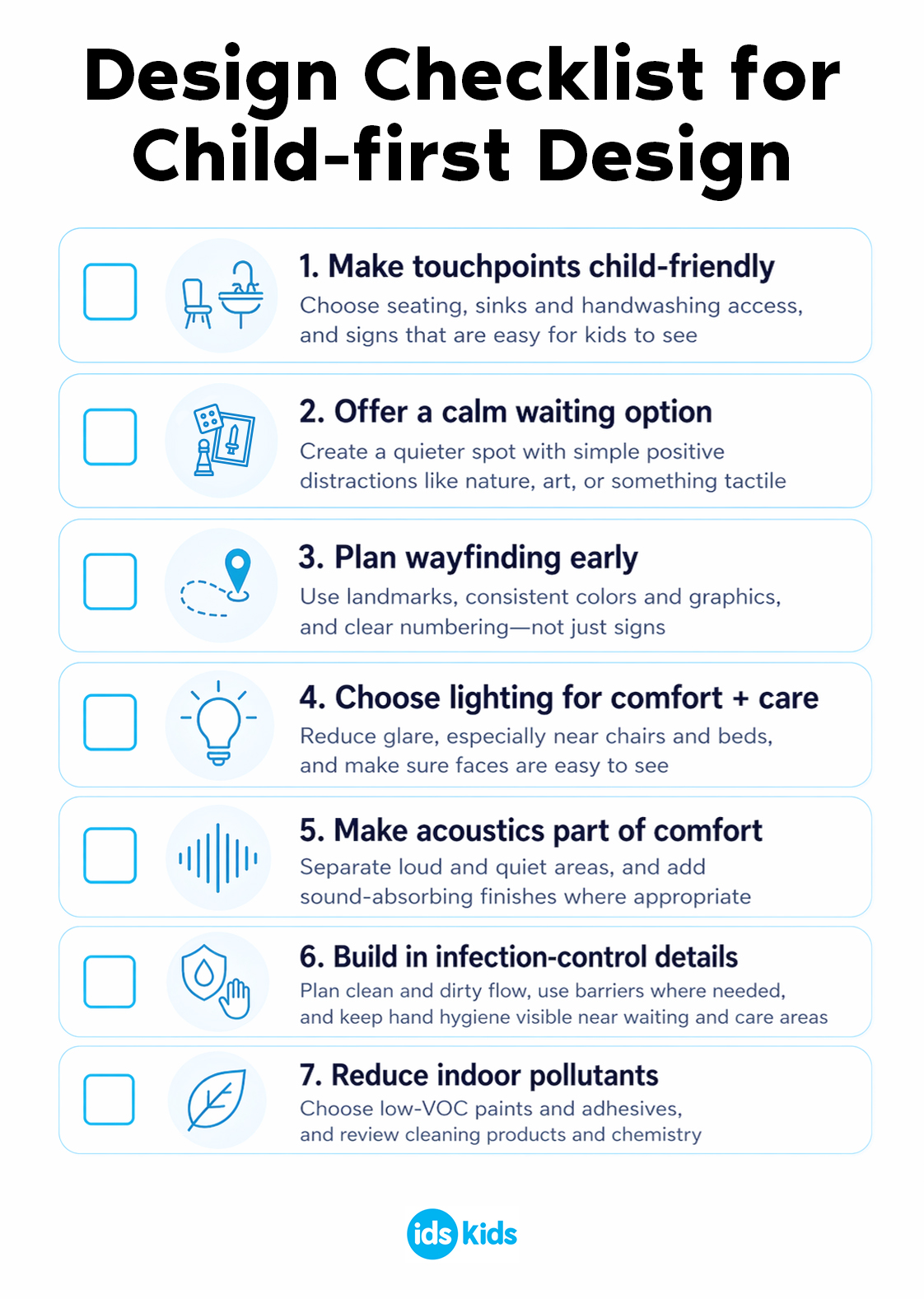
□ Child-scale touchpoints
Seating, sinks and hand hygiene access, and signage sightlines should all work at a child-friendly scale. (U.S. DOJ, 2010)
□ A calm option in the waiting area
Include a quieter sub-zone with simple, positive distractions such as nature imagery, art, or a tactile element. (Jiang, 2020; Vetter et al., 2025)
□ Plan wayfinding early
Use landmarks, consistent color and graphic logic, and clear numbering rather than relying on signage alone. (Defense Health Agency, 2022)
□ Specify lighting for both comfort and task performance
Control glare, especially near chairs and beds, and provide readable vertical illumination for faces. (IES, 2025)
□ Treat acoustics as part of clinical comfort
Separate loud and quiet functions, and add sound absorption where cleanability allows. (WHO, 1999; FGI, 2018)
□ Address infection control in the details
Plan clean and dirty flow, use surface barriers where appropriate, and make hand hygiene visible near waiting and care zones. (CDC, 2016)
□ Limit indoor pollutants
Choose low-VOC paints and adhesives, and review cleaning chemistry as part of material selection. (EPA, 2025; Harvard Center on the Developing Child, 2025)
Great child-first design is more than a trend in pediatric dental and medical spaces. It is a practical approach to creating pediatric office interiors that feel safer, calmer, and easier for children and caregivers to navigate. By combining sensory-friendly design, child-scaled features, clear wayfinding, easy-to-clean materials, and imaginative pediatric decor, clinics can create spaces that support both clinical function and emotional comfort. The result is a pediatric environment that not only looks inviting, but also helps families feel cared for from the moment they arrive.
Looking to create a more welcoming, functional space for children and families? Imagination Design Studios creates custom child-first environments for pediatric dental offices, medical clinics, therapy spaces, and other child-friendly businesses.
References
- American Academy of Pediatric Dentistry. (2023). Nonpharmacological Behavior Guidance for the Pediatric Dental Patient.
- American Academy of Pediatric Dentistry. (2024). Behavior Guidance for the Pediatric Dental Patient (Latest revision 2024; published in the Reference Manual of Pediatric Dentistry 2025).
- Cermak, Sharon A., et al. (2015). Sensory-adapted dental environments for children with autism: randomized pilot/feasibility evidence.
- Defense Health Agency. (2022). Wayfinding Guidelines and Signage Standards for MHS Facilities.
- U.S. Environmental Protection Agency. (2025). Volatile organic compounds (VOCs) and indoor air quality overview.
- Harvard Center on the Developing Child. (2025). Air Quality Affects Early Childhood Development and Health.
- Jiang, Shan. (2020). Positive distractions and play in pediatric public spaces: literature review.
- Gripko, Michaela, et al. (2023). Systematic review: effects of ED physical environment on children and families.
- Ulrich, Roger S.. (2000). Supportive design: stress reduction, coping, and healthcare outcomes.
- Ulrich, Roger S., et al. (2008). Review of evidence-based healthcare design research.
- U.S. Department of Justice. (2010). 2010 ADA Standards for Accessible Design.
- Centers for Disease Control and Prevention. (2016). Summary of Infection Prevention Practices in Dental Settings: Basic Expectations for Safe Care.
- World Health Organization. (1999). Guidelines for Community Noise.
- Facility Guidelines Institute. (2022). Guidelines for Design and Construction of Outpatient Facilities: Major additions and revisions..
- Shepley Bulfinch. (n.d.). Boston Children’s Hospital Hale Family Building case study.
- Stanford Children’s Health. (n.d.). Finding your way.
- Illuminating Engineering Society. (2025). Recommended Practice: Lighting Hospital and Healthcare Facilities.
