In the digital age, a strong online presence is crucial for family-friendly businesses. At IDS, we understand the unique challenges you face and are here to help. Our goal is to support businesses like yours by providing valuable marketing tips that can enhance your visibility and engagement. This blog will guide you through essential SEO tips for beginners, ensuring you have the tools to get ahead and attract more families to your business website.
While you might not be handling the SEO for your business website yourself, having some basic knowledge of SEO and simple tips to improve it can greatly enhance your communication with your web developer or SEO specialist. Understanding these fundamentals will empower you to make informed decisions and contribute to the success of your online presence.
10 SEO Tips to Get Your Started
1. Keywords
An SEO keyword is a specific word or phrase that people use in search engines to find relevant content online. You want your website to include these words and phrases.
Find Simple Keywords: Think about what words people might use to find your business online (e.g., “kids’ activities near me” “child-friendly mall”).
Use Keywords Everywhere: Include these keywords in the titles, descriptions, and content on your website.
2. Page Titles and Descriptions
Page Titles: Make sure every page on your website has a clear title that tells what the page is about. For example, a weak title like “Our Fun Zone” vs the more effective “Interactive Play Area for Kids | Fun Zone in [City Name]“.
Descriptions: Write a short description for each page that summarizes what it’s about. This helps search engines and people understand your page.
3. Quality Content
Write Helpful Content: Create content that answers questions or provides information people are looking for, like your services, events, and how to get involved.
Regular Updates: Add new content regularly, like blog posts about upcoming events or recaps of past activities.
4. Local Information
Google My Business: Set up a Google My Business profile. It’s free and helps people find your business. Include your business’s name, address, phone number, and hours.
Local Keywords: Use phrases like “child-friendly [your type of business] in [your city]” on your website.
Check Your Site on a Phone: Make sure your website looks good and works well on a phone. Many people will look for your business on their mobile devices. Search engines will even penalize you for having an ineffective mobile version of your website.
6. Easy Navigation
Simple Menu: Create a clear menu that helps visitors easily find what they’re looking for, such as your services, location, and contact information. Avoid using unique or creative words; stick to simple, basic terms that both humans and search engines can easily understand. For example, a weak menu header would be “Discover Our Wonders” vs a more clear “Services”, or “Find Us” vs “Location”.
Highlight Important Info: Make sure important information like your address and hours are easy to find. Make sure this information matches what is listed in your Google Business profile.
7. Photos and Images
Add Pictures: Use photos of your business, events, and activities. It makes your website more engaging.
Describe Your Photos: When you upload a photo, add a short description (this is called alt text or alt attributes) to tell search engines what the photo is about. Alt text also allows screen readers to describe on-page images for people who are blind or visually impaired.
8. Secure and Fast
HTTPS: Make sure your website uses HTTPS (a secure website address) not just HTTP. It helps protect visitors’ information.
Keep Info Updated: Make sure your address, hours, and contact info are always up to date everywhere they appear online.
Be Patient: SEO takes time. Don’t expect immediate results, but keep improving your website regularly.
10. Ask for Help
Basic Tools: Use free tools like Google Analytics to see how people find and use your website. It helps you understand what’s working and what needs improvement.
Simple Tutorials: Look for beginner tutorials online or ask for help from someone who knows a bit about websites.
By following these basic steps, you can improve your child-friendly business’s online presence and make it easier for people to find and connect with you.
Did you find this marketing topic interesting? Here are some related articles for you to explore:
As decision-makers and board members of state public health departments, you have the power to transform the patient experience in your facilities. While theming is often associated with private practices, it’s time to recognize its potential in public health settings. By incorporating thoughtful design elements, you can create welcoming environments that not only put patients at ease but also contribute to better health outcomes.
The Impact of Environment on Health
Research consistently shows that the physical environment plays a crucial role in patient well-being. A welcoming, themed space can reduce stress, anxiety, and even pain perception. It’s not just about aesthetics; it’s about creating an atmosphere that promotes healing and comfort.
Evidence-based design in healthcare highlights the importance of patient-centered healthcare environments. Thoughtfully designed public health facility interiors, such as hospital waiting room design ideas and nature-inspired spaces, can foster healing while improving patient outcomes.
Why Theming Matters in Public Health
Public health facilities often serve as the frontline of care for diverse populations, many of whom may face heightened stress and anxiety when seeking medical assistance. Imagine walking into a waiting room that feels cold and impersonal versus one that evokes the warmth of a beach or the serenity of a forest. The impact on a patient’s mental state can be profound.
Studies on healthcare theming impact reveal that thoughtfully designed environments improve patient well-being, reduce anxiety, and even speed up recovery times. For children, who may struggle to understand or cope with medical procedures, a playful, themed environment—whether it’s a pediatric waiting room theme or a hospital play area design—can provide a sense of safety and control. These child-friendly hospital designs can make a significant difference by creating spaces that support therapeutic healthcare environments.
Themed murals on private ER room doors.
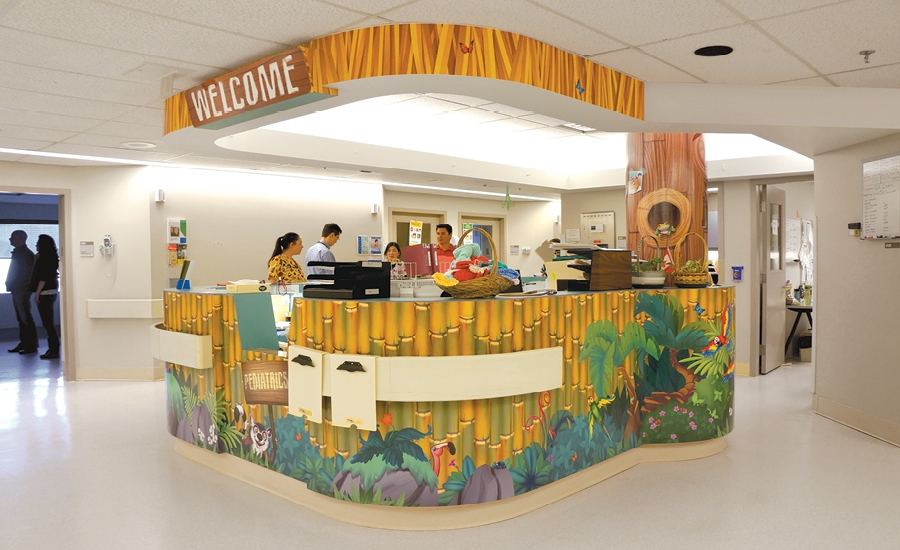
Jungle themed wall mural for hospital pediatric unit welcome desk.
A Worthwhile Investment
Implementing theming in public health facilities is not just about creating a pleasant atmosphere. It’s an investment in patient outcomes, family experiences, and overall public health. By creating welcoming environments, we can:
Reduce patient anxiety and stress using stress-reducing design in healthcare
Improve compliance with treatment plans through interactive patient spaces in healthcare
Enhance the overall patient experience with family-friendly hospital designs
Support the well-being of healthcare staff through healing environments in public health
Therapy room with calming wall mural.
Real-World Success: Stollery Children’s Hospital
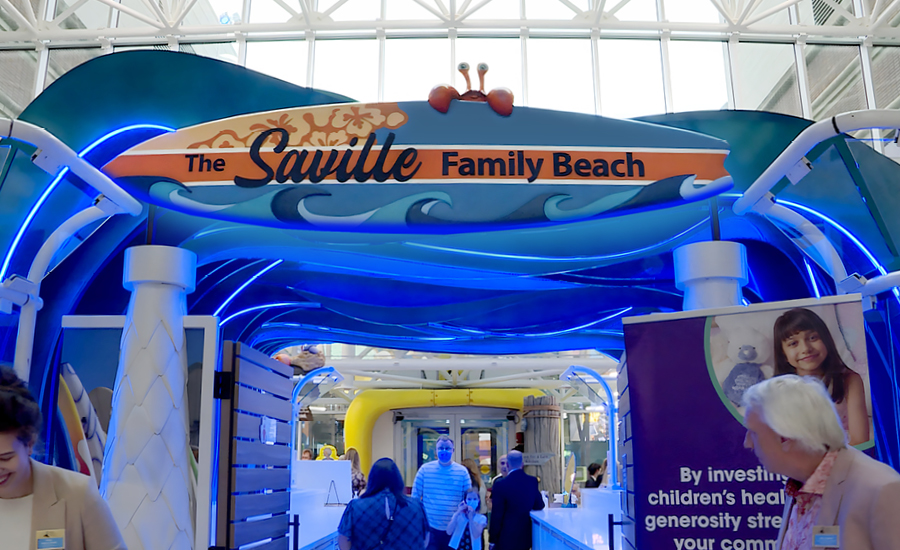
The entrance to Stollery’s new family area, referred to by kids as “The Beach”.
At Stollery Children’s Hospital, we had the privilege of designing a family area and children’s play space called “The Beach.” This thematic space offers a safe, engaging environment where young patients can regain a sense of control over their activities.
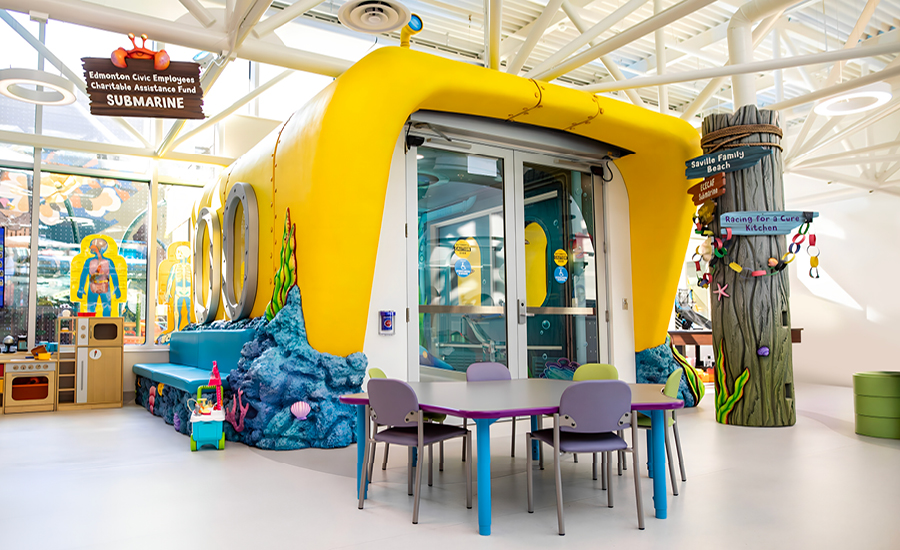
Inside Stollery’s new family area.
Alison Naylor, a Child Life Specialist at Stollery, highlighted the transformative impact of this space:
“The Beach is really a safe space for them to come into being control of their activities and what they want to do. Just giving them back an opportunity to be in control of some elements of their care is vitally important to their growth and development and their coping in hospital.”
Parents have also expressed their gratitude for the emotional relief such spaces provide. Christian Stevens, a parent of a patient, shared:
“You know the adrenaline kicks in and you’re just trying to figure out what’s going on with your kid, how to get him the care he needs. It was a relief after five days of being in here to see him smiling, giggling. For us just to play as a father and son, I wouldn’t have expected this to be something we could do at a hospital.”
Christian Stevens and his son playing at “The Beach”.
These testimonials underscore the role of theming in not only improving patient experiences but also in strengthening family bonds during difficult times. Such spaces reflect best practices in healthcare facility design, combining aesthetics with functionality to create calming healthcare environments.
Moving Forward: Making Theming Accessible
Incorporating thematic design into public health facilities doesn’t have to break the budget. Collaborating with experienced design firms can help health departments develop cost-effective solutions tailored to their unique needs. By prioritizing spaces that resonate with the community, health departments can create environments that promote healing, foster resilience, and reflect their mission to serve all patients with dignity and care.
Consider options like sensory rooms for healthcare facilities, hospital play area equipment suppliers, and therapeutic spaces that integrate art and design—all contributing to the broader goal of improving patient experience in public health facilities.
Conclusion
Theming isn’t just for private practices or pediatric wards—it’s a powerful tool that can transform any public health facility into a beacon of comfort and healing. For board members and decision-makers, investing in thematic design is an opportunity to enhance patient care, improve health outcomes, and make a lasting impact on the communities you serve.
Take the step toward creating spaces that heal both body and spirit. From evidence-based design strategies for improved patient outcomes to nature-inspired hospital interiors, your patients—and their families—will thank you.
Did you find this topic interesting? Here are some related articles for you to explore:
At IDS, we live and breathe environmental theming, and we understand that this concept might be new to some. That’s why we’re here to shed some light on the magic behind it. Themed environments are the beating heart of immersive entertainment, enveloping guests in meticulously crafted settings that elevate the ordinary into the extraordinary. Whether it’s a wizarding world, a tropical paradise, or a futuristic cityscape, themed environments come to life with astounding realism and creativity.
We’re here to answer the most common questions about theming. Welcome to a world where fantasy meets reality, where every detail is designed to transport you into stories and experiences beyond your wildest dreams!
What Exactly is a Themed Environment?
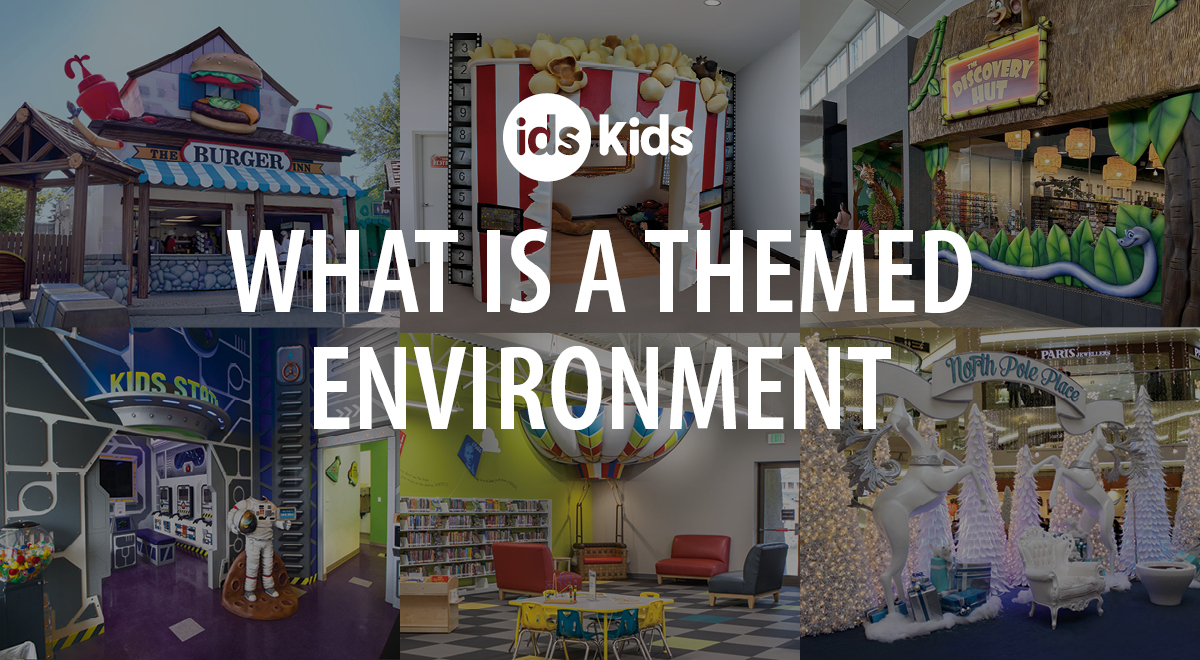
A themed environment is a specialized area designed to create an immersive experience through detailed storytelling and design. These spaces are often part of amusement parks, museums, restaurants, retail stores, and even educational settings. The key to their magic lies in their ability to engage all the senses, using architecture, technology, light, sound, and even scent to create a cohesive and captivating world.
How Do Themed Environments Elevate Experiences
Storytelling Through Design: Every element in a themed environment contributes to the narrative. Designers use decor, music, and even employee costumes to reinforce the theme and enhance the story being told. This attention to detail ensures that guests are not merely observers but active participants in the narrative unfolding around them.
Emotional Engagement: Themed environments are designed to evoke specific emotions and reactions. Whether it’s the thrill of adventure in a pirate’s cove or the awe of a starlit galaxy far, far away, these spaces use their themes to connect on an emotional level, creating memories that last a lifetime.
Educational Opportunities: Many themed environments are more than just entertainment. They are educational powerhouses that engage children and adults alike in learning through interactive exhibits and themed storytelling, making education a thrilling adventure.
Enhanced Branding: For businesses, themed environments are an excellent tool for branding and customer engagement. They transform traditional business models by turning spaces into unique brand experiences that communicate identity and values in a memorable way.
What are Examples of Themed Environments
Theme Parks: Places like Disneyland and Universal Studios are iconic examples of themed environments where every ride, shop, and restaurant serves to enhance the overall theme of adventure and fantasy.
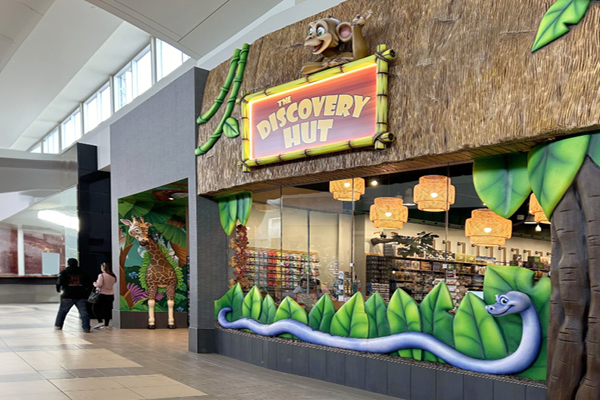
Retail Stores: Certain flagship stores use themed designs to enhance shopping experiences. For instance, the Discovery Hut is a game and toy store with a jungle adventure theme. Every location has a jungle facade that carries through the interior.
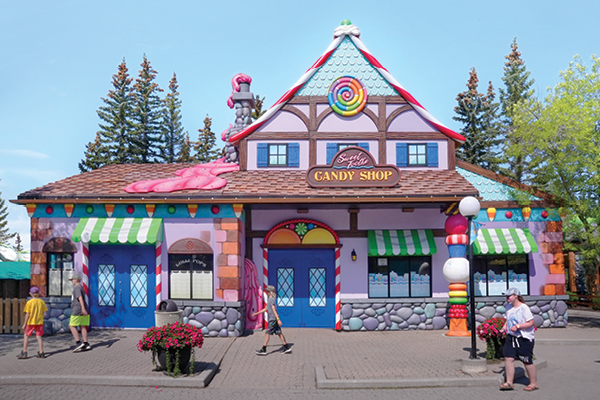
Restaurants and Cafes: Themed dining experiences are increasingly popular, offering not just food but an escape into another world. Speakeasy-style bars and restaurants draw on the prohibition period for their decor and styling. A candy shop that is themed to look like it is made out of candy is a great example of an immersive theme.
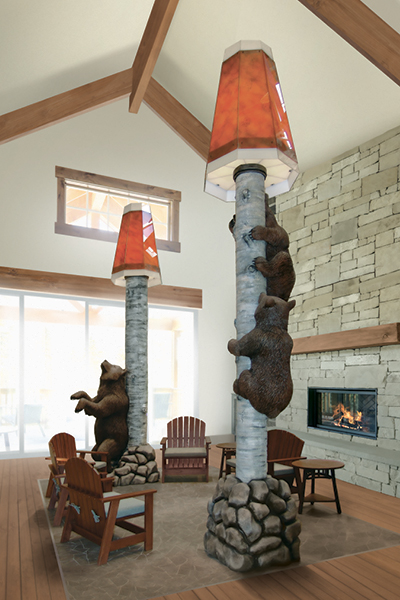
Hotels and Restort: By creating themed rooms, suites, and common areas, hotels can offer unique experiences that cater to guests’ imaginations and preferences. A lodge with a nature theme is a basic example. The Fantasyland Hotel at the famous West Edmonton Mall is the perfect example of a hotel using theming as a selling feature.
Exhibits and Museums: Museums often utilize themed environments to showcase exhibits. A dinosaur exhibit, for instance, might recreate prehistoric environments, complete with sounds, vegetation, and, of course, giant dinosaurs to transport visitors back in time.
Dental Offices with Children’s Theming: Pediatric dental practices are transforming the way young patients see visits to the dentist through themed environments. A pirate-themed dental office, for example, can make a child feel like they’re on an adventure, easing anxiety and making dental care fun.
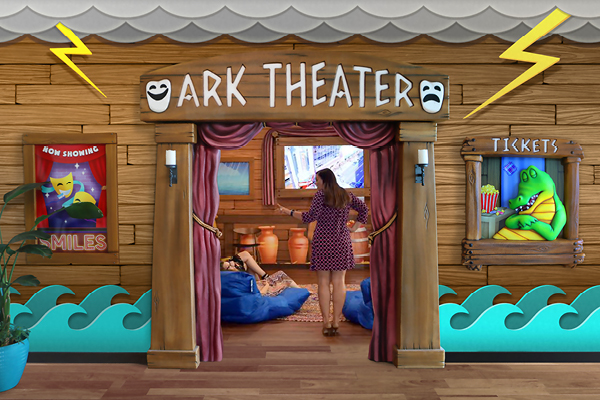
Children’s Areas in Churches: Many churches create themed areas for their younger congregants to make religious education more engaging. These might include Noah’s Ark-inspired play areas or Bible story-themed rooms, helping children learn through play and storytelling.
Children’s Libraries: Libraries are adopting themes to make reading more enticing for kids. From enchanted forests to space stations, these themes help ignite the imaginations of young readers, making every book an adventure waiting to happen.
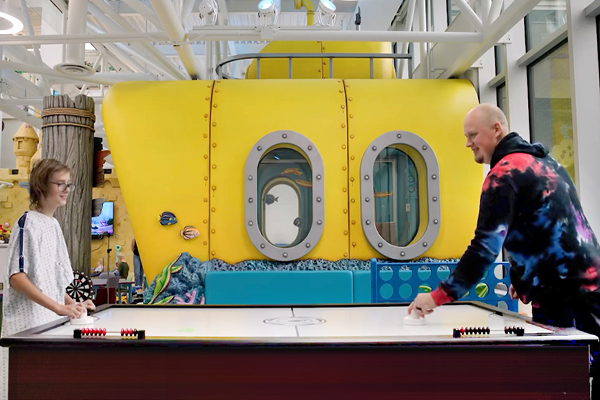
Hospital Pediatric Wards: Hospitals are increasingly turning to themed environments to make their pediatric wards less intimidating for children. Themes such as superhero cities or underwater adventures can make a hospital stay less frightening and more intriguing for young patients.
Who Creates the Magic Behind the Scenes
Creating a themed environment is a multidisciplinary endeavor involving architects, designers, artists, engineers, and storytellers. Technology plays a crucial role, with modern advancements like soundscapes and immersive lighting effects pushing the boundaries of what’s possible in creating deeply immersive experiences.
At IDS, we specialize in bringing these fantastical worlds to life. Our team of expert designers, architects, and storytellers work collaboratively to transform your space into a captivating themed environment that meets your specific needs. From concept to completion, we handle every aspect of the project, ensuring that each detail is meticulously crafted to create an immersive and engaging experience. Whether you are looking to enhance a retail space, a hospital pediatric ward, or any other child-friendly area, we are here to turn your vision into reality.
The Magic of Themed Environments
Themed environments are not just about seeing a new world; they’re about feeling and experiencing it firsthand. They remind us that with a little creativity and lots of dedication, the line between reality and imagination can blur beautifully. Whether for fun, education, or brand engagement, themed environments offer a unique way to experience stories in a way that engages, educates, and entertains.
So next time you step into a themed space, take a moment to appreciate the incredible artistry and effort that goes into creating these magical worlds!
Want some more inspiration on themed environments?
For children diagnosed with autism, their surroundings play a crucial role in determining their sense of ease and overall health. Extensive research has delved into the correlation between color and light and the well-being of children with Autism Spectrum Disorder (ASD). In this article, we’ve compiled key insights from these studies.
Enhancing Interior Spaces for Children with Autism: A Guide to Color and Light
We are intrigued by the discoveries unearthed in these studies and feel compelled to share them. We aim to equip architects, designers and business owners who are creating autism centers, ABA therapy facilities, and other spaces dedicated to those on the spectrum. We hope these valuable insights help to craft environments better suited to the needs of these children. Read on to learn more.
Understanding Autism
Autism is characterized by difficulties in social communication and interaction. People with autism may also have sensory sensitivities, making them particularly sensitive to stimuli in their environment. This includes sensitivity to colors and lights.
Color Preferences: According to the study, neutral colors like grey, green, blue, and white were generally preferred by children with autism. Bright colors like red and yellow were found to have adverse effects on them.
Light Preferences: Natural light was favored whenever possible, while artificial lighting, especially fluorescent lights, was generally disliked due to flickering and negative effects on perception.
Grey color has no effect, either positive or negative, on those with ASD. White colors if used alone were found to have a negative effect.
Preferred lighting techniques to use in spaces for people with autism include more natural styles of lighting:
Indirect sunlight, controlled with the use of curtains
Indirect tungsten lighting
Indirect white LED light
Use dimmers to control artificial lighting
A study conducted by Marine Grandgeorge and Nobuo Masataka on “Atypical Color Preference in Children with Autism Spectrum Disorder” [2] has similar findings. This study provides valuable insights into the atypical color preferences of children with autism spectrum disorder.
Children with ASD exhibited distinct color preferences compared to children with typical development (TD). While TD children showed a typical preference for red and blue, boys with ASD displayed an aversion to yellow and a heightened preference for green and brown. These differences were consistent across different age groups within the ASD population.
The aversion to yellow in children with ASD may be linked to their heightened sensitivity to sensory stimuli, particularly luminance. The preference for green and brown aligns with anecdotal reports and may reflect a unique perceptual experience in children with ASD. Neurological explanations suggest disruptions in color processing pathways, contributing to these atypical preferences.
To add on to these findings, another study, “A case study on the effect of light and colors in the built environment on autistic children’s behavior” [3], found that the sensitivity of autistic children to colors plays a crucial role in their perception and interaction with their environment. Research suggests that the choice of colors in interior spaces can significantly impact their mood, behavior, and learning outcomes.
By incorporating autism-friendly color palettes such as pastel shades and muted tones while avoiding bold and bright colors, indoor environments can be designed to provide a soothing sensory experience for autistic individuals.
This study also explored how visual aids like landmarks and color-coding can simplify navigation for autistic individuals. Researchers observed children’s behaviors in their classrooms beforehand. Implementing a simple navigation system with color-coded paths can make it easier for visually sensitive autistic individuals to move around without fear. Also, colorful mats were utilized to create color shapes on the floor, enhancing the accessibility and navigability of areas for autistic children.
What Are the Implications for Designers
Use neutral and muted colors, avoiding bright and saturated hues.
Prioritize natural lighting and minimize the use of fluorescent lights.
Consider the use of color coding in wayfinding solutions.
Consider the individual needs and sensitivities of each child when designing spaces.
Children’s spaces are meant to be colorful, and when crafting a business tailored for children, embracing vibrant and playful colors becomes essential for creating an inviting and engaging environment. If your space caters to all children, you don’t have to be scared of yellows, pinks, and reds! Whether it’s a daycare center, a toy store, or a children’s clothing boutique, incorporating bright hues and cheerful designs can captivate young imaginations and foster a sense of joy and excitement.
However, when creating specialized spaces for children on the spectrum, it’s important to be mindful of color and its effects. Designers should prioritize light, color, and space considerations in environments that cater to autistic children. By understanding their preferences and sensitivities, architects and designers can play a crucial role in enhancing the well-being and comfort of these children in interior spaces, ensuring inclusivity and accessibility for all.
Further research and attention to this area are needed to continue improving design practices for individuals with autism.
For our article today, we reference the studies found here:
In the landscape of consumer choices, the debate between value and expense often takes center stage.
The Boots Theory of Socioeconomic Disparity, as originally coined by Terry Pratchett in his Discworld series, suggests that people with less disposable income actually end up spending more in the long run because they can only afford cheaper, low-quality items that need frequent replacement.
The example goes, rather than investing in one expensive, quality pair of boots that may last decades or even a lifetime, they’ll buy a cheaper alternative that wears thin quickly and must be replaced year after year, costing more in the long run.
This theory can be reframed to emphasize the benefits of paying more for a quality product that is durable, well-made, and comes with a warranty. Let’s call this the Investment in Quality Theory. It’s not a catchy name, but the idea should catch your attention. While the upfront cost of a high-quality product may be higher, the long-term benefits and cost savings can outweigh the initial expense.
Here’s a better way you can understand this concept. In the realm of consumer choices, there exists a pragmatic approach to purchasing that advocates for paying more upfront to secure a product of superior craftsmanship, durability, and guaranteed longevity. Much like the Boots Theory highlights the cyclical struggle of those with limited resources, this theory encourages consumers to break free from the cycle of frequent replacements and ongoing expenditures on subpar items.
Imagination Design Studios, with our commitment to quality theming, embodies this theory, providing not only an immediate transformative experience but also long-term advantages that justify the initial expense.
Long-Term Patient and Business Benefits
Investing in IDS theming is not just about aesthetics; it’s a strategic move that yields lasting benefits for both patients and businesses:
Substantial ROI: Clients report significant returns on their investment, with increased patient numbers and revenue. The theming becomes a driving force behind business growth, exemplified by case studies where clients attribute an additional $800,000 to theming, contributing to a substantial return on investment.
Marketing and Patient Growth: Themed environments are not just decorative; they serve as powerful marketing tools. Examples, such as an office experiencing a surge in new patients after installing an octopus-themed feature, highlight the tangible impact of IDS theming on patient growth.
Imagination Design Studios’ commitment to quality theming aligns seamlessly with the Investment in Quality Theory. The upfront expense transforms into a strategic investment, delivering unparalleled value in terms of patient experience, business growth, and long-term cost savings.
What do we say to potential clients who say we are expensive?
Yes, we are.
But our company – and our existing clients – believe that price is a reflection of quality. You get what you pay for.
IDS Kids recognizes the diverse financial landscapes of its clients and offers various avenues for customization and budget flexibility:
Financing Options: Many clients seamlessly integrate IDS theming into their building costs or marketing costs, making discussions with local funders, such as Bank of America, easier. This financial support reinforces the idea that IDS products are not just expenses but strategic investments.
Marketing Effectiveness: We know theming goes beyond traditional advertising methods, offering a more effective strategy to attract new patients. The immersive experience created by themed environments contributes to increased patient referrals and positive online reviews, underlining the long-term benefits of the investment.
Affordable Starting Points: We suggest starting with budget-friendly options, such as murals from the IDS Essentials™ Collection. This allows our clients, especially new grads, to initiate theming in a cost-effective manner, ensuring a positive first step toward a fully themed environment.
Phased Implementation: We encourage a phased approach to theming, allowing clients to add elements over time as their budget permits. This strategic implementation ensures a cohesive look while demonstrating a commitment to the long-term vision.
Testaments to Our Quality
We have two great stories from our existing clients that we would like to share. This one happened very recently.
Let’s look at “Dr. M”. He had already decked out his first office with our themed creations, creating a woodland wonderland for little ones. But when it came to opening a second office with a new business partner, convincing them of the magic of theming was a bit of a challenge.
Concerned about costs, they decided to shop around. They ordered a ‘test piece’ from a cheaper company to see how they compared. Upon its arrival, disappointment swiftly followed. The subpar quality and lackluster craftsmanship fell short of their expectations, failing to capture the details and personality that made our pieces stand out.
Realizing the undeniable disparity in quality, Dr. M and his partner swiftly returned to us, recognizing the value in our products. With renewed confidence, they worked with our team to adorn their second office with our fun and friendly pieces.
In the end, their experiment showed them (and proved to us) that our commitment to quality and attention to detail is worth any additional expense. And as they watch kids explore and play in their themed office, they know they’ve made the right choice for endless smiles and adventures.
Another story from a few years ago also involved another experiment in price comparison.
“Dr. L” faced a similar conundrum when she sought to revamp her children’s space. Despite being drawn to IDS’s renowned expertise, she hesitated due to cost concerns, opting instead for a local company.
However, the theming delivered by the local company was disappointing and ended up going straight into the trash. Disheartened but determined, Dr. L turned to IDS, recounting her story. IDS, understanding her plight, delivered exactly what she wanted and more. This experience reinforced the importance of investing in quality, proving that sometimes, it’s worth paying a bit more for the right outcome.
As clients share success stories and the transformative power of IDS theming, it becomes clear that the initial investment is a small price to pay for the enduring benefits that extend far beyond mere aesthetics.
Invest in Our Quality
With IDS Kids, you’re not just paying for theming. You’re investing in 30 years of research, development, and unparalleled experience. Our themes transform patient experiences and are backed by warranties that assure their longevity. We believe in creating environments that inspire, comfort, and last. Yes, our products are an investment — an investment in quality that continues to pay dividends in smiles, growth, and community impact.
Join us, and transform your space into a world of wonder.
Are you looking for more information about theming with IDS Kids?
In today’s competitive business landscape, securing funding through grants can be a game-changer for your organization. Grants offer the financial support needed to fuel growth, innovation, and social impact. However, the grant application process can be complex and highly competitive.
To increase your chances of success when applying for a grant, consider these valuable tips and tricks:
Research, Research, Research:
Before diving into the application process, invest time in researching potential grant opportunities. Identify grants that align with your business goals, mission, and industry. Each grant may have unique criteria and priorities, so it’s crucial to tailor your applications accordingly.
Tip: Research the grant-offering institution to understand their goals, values, and objectives. This will help you tailor your application to align with their interests.
Build Strong Relationships:
Networking is key in the world of grant applications. Establish connections with grantmakers, attend industry events, and join relevant associations. Building relationships can provide insights, recommendations, and even a foot in the door. After all, it’s who you know.
Craft a Compelling Story:
Your application should tell a compelling story about your business, its impact, and why it deserves the grant. Highlight your mission, achievements, and the specific project or initiative the grant will support.
Tip: Highlight your company’s credibility. Use testimonials, data, and success stories to demonstrate why your business is a worthy recipient of the grant.
Understand the Requirements:
Carefully read and understand the grant’s guidelines, requirements, and deadlines. Ensure you meet all eligibility criteria and provide all necessary documentation. Missing a crucial element can lead to rejection.
Tailor Your Proposal:
Customize each grant proposal to match the grant’s focus and objectives. Clearly demonstrate how your project aligns with the grantor’s mission and how their funding will make a difference.
Demonstrate Sustainability:
Grantmakers often want to see that their investment will have a lasting impact. Outline a clear plan for how your project or initiative will be sustained beyond the grant period.
Budget Wisely:
Create a detailed and realistic budget for your project. Be transparent about how grant funds will be allocated, and ensure that every dollar serves the intended purpose.
Seek Professional Assistance:
If necessary, consider hiring a grant writer or consultant with expertise in your industry. They can help you craft a compelling proposal and navigate the complexities of the application process.
Review and Edit:
Before submitting your application, review it meticulously for errors, clarity, and completeness. Consider seeking feedback from peers or mentors to ensure your proposal is as strong as possible.
Tip: Organize all required documents, such as financial statements, tax returns, business licenses, and letters of recommendation, in advance.
Follow Up:
After submitting your application, follow up with the grantmaker as appropriate. Express your gratitude for the opportunity and inquire about the timeline for decisions. Maintain a positive and professional relationship.
Remember that grant applications can be highly competitive, and rejection is common. Use each application as a learning opportunity, gather feedback, and continually refine your approach. By applying these tips and tricks, you can increase your chances of securing the funding needed to propel your business forward and make a positive impact on your community or industry.
Applied Behavior Analysis (ABA) is widely recognized as a safe and effective treatment for autism, Down Syndrome, and other diagnoses. Recent estimates from the Centers for Disease Control and Prevention indicate a 178% increase in school-age children diagnosed with Autism Spectrum Disorder (ASD) from 1 in 150 in 2002 to 1 in 54 in 2016″. This statistic highlights the growing need for effective treatment environments.
As more families seek out centers to help improve the lives of their children who are neurodivergent, including those with Autism Spectrum Disorder and Down Syndrome, it’s essential that organizations are able to provide a customized and low-stress environment for individuals of all ages.
Thoughtful autism therapy center design can play an important role in helping centers create a positive setting for their patients and employees alike. However, did you know that using custom theming can enhance your organization’s business practices as well? Custom theming can become an all-in-one solution to address your organizational goals, whether it be through increasing patient experiences and building retention, expanding your organization’s marketing campaign, or finding ways to build your donor list.
Let’s get into how applying custom theming can address each of these goals.
Enhance Patient Experiences and Build Retention in Your Autism Therapy Center
ASD, or Autism Spectrum Disorder, can be a difficult struggle for children, making the environment and atmosphere in which they receive treatment incredibly important for their overall experience.
Custom theming has become widely popular as an effective way to create a stimulating atmosphere for ASD patients. By using unique decor and furnishings of specific colors, shapes, textures, and sizes that may be beneficial to ASD individuals, centers can truly create a warm and inviting space focused on their individual needs.
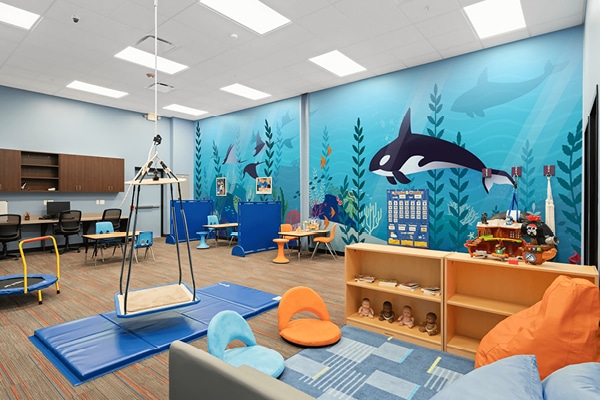
Example of an ABA therapy center with a calming underwater mural.
Furthermore, certain activities such as crafting, playing games, and reading books are personalized to their interests while different aromatherapy techniques like scent diffusing can also have calm and revitalizing effects on ASD kids. Themed centers can make the patient experience more enjoyable and effective for ASD kids allowing them to focus on the genuine care being provided by the staff.
Example of an Applied Behavior Analysis therapy center with underwater theming.
By improving patient experience, you are directly showing your kids, and especially, the parents, that you genuinely care about how the child feels when they’re at your facility.
Example of a physical therapy center with sports themed animal murals.
Custom theming can help enhance not only the experience of their time at your facility but also the outcomes through the practical uses provided by it. In turn, the parents will recognize the effort being put in and be less likely to want to transfer their child to a different location. These parents may also become advocates for your organization and create new potential clients to come to your facility.
Expand Your Organization’s Marketing Campaigns Through Custom Theming Strategies
Custom theming can be an effective way to strengthen the marketing campaigns for autism centers, as it adds a personalized touch that resonates with ASD clients and their families. By carefully considering the tone, logo, visuals, and messaging in their campaign designs and content, ASD centers can create cohesive experiential campaigns that — when paired with content tailored to ASD stakeholders — provide an effective, meaningful approach to outreach. Not only does this help ASD centers build relationships with those they serve, but it further shows commitment to everyone involved in the effort.
Custom theming is not only tied to the marketing efforts of the organization but can provide an opportunity for organic marketing growth, specifically when it comes to user-generated content.
Photo op for customers to promote your business on social media.
User-generated content is made up of photos, videos, or public comments made about your organization that visitors have made online. These can provide organic branches for your marketing campaign to help promote your organization, especially if your facility has built-in photo ops within its space. A fun environment can invite parents to take photos of their child within your space and share it online for others to see and potentially tag you within their posts. This can help grow your organization’s marketing effort and provide eyes to your facility.
Ultimately, custom theming offers autism centers a way to differentiate themselves from competitors; create a unique identity; increase brand recognition; maximize engagement; and drive success for both short-term and long-term marketing goals. This leads to our next point…
Enhance Fundraising and Donor Engagement for Autism Support Centers
If your organization is dependent on the charity of others, this is especially important. Having an increase in funding can allow your organization to improve its resources, provide more opportunities, and most importantly, create an all-in-all better experience for your clients attending your facility.
With custom-theming provides a quality patient experience and pairing that with the marketing potential of having a themed design can provide, it can heavily improve the image that your facility outputs. Having a healthy and attractive image will give potential donors a reason to notice and provide support to your facility. Especially showing the amount of effort being put into the betterment of your clients, donors will recognize your hard work and the outcomes that come out of it.
This attention doesn’t stop at only potential donors but can create a spotlight for potential sponsorships from other organizations to help your facility. These sponsorships can create new branches within your marketing campaigns and feed into the cycle of new eyes, new donors, and new improvements to your facility.
Donor wall ready to be filled.
The Impact of Custom Theming on Autism Therapy Centers: A Summary
No matter what size autism center you’re running, the importance of creating a space that considers your individual clientele can have a tremendous amount of positive impact. A comprehensive study found that early intervention programs for very young children with autism, some as young as 18 months, significantly improve IQ, language ability, and social interaction.
Custom theming can provide patients and families with comfort and therapeutic benefits while also furthering your organization’s marketing efforts, and donor list, and building customer retention. Investing in custom theming is an investment in the patient experience and can pay off greatly; just make sure to keep the focus on your key demographics needs when designing your space.
Here at Imagination Design Studios, we understand that custom theming isn’t always easy, so if you’re having a hard time visualizing how this might come together for your autism center or build out work within a budget visit our website to speak to one of our creative consultants today! We are here to help you create an innovative, therapeutic, and welcoming atmosphere for all those utilizing your services.
Dave Nolan, the President of IDS, is a father of two sons, one of whom has autism. While navigating dental and medical appointments, he noticed the heightened stress and anxiety his son experienced when entering unfamiliar environments. This observation led him to wonder, “There must be a way to improve this experience for children in similar situations.” At Imagination Design Studios, our “Why” is driven by our deep belief in the transformative power of positive, welcoming neurodivergent-friendly environments in a child’s development.
Interested in learning more? Check out these related resources on themed environments and their benefits:
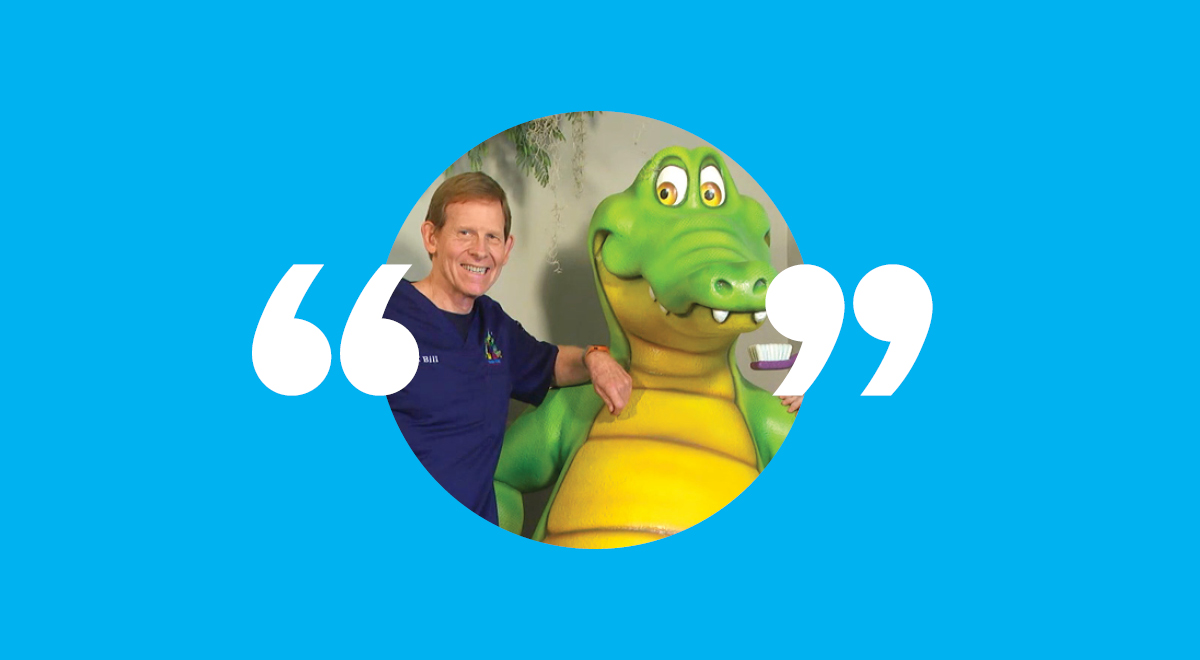
Dr. Bill Martin, the founder of Martin Kids Dental is excited to walk into his office every day to do what he does best, make a difference in the lives of his patients.
Dive into our interview with Dr. Martin below and unveil how theming has enhanced his love for what he does and has affected his business better than he could have expected.
Dr. Martin: I just had an orthodontist’s office before, and then I decided to add pediatric dentistry and wanted to create a unique and very different environment for kids. Then IDS came along and did a perfect job.
What made you want to choose a Bayou theme?
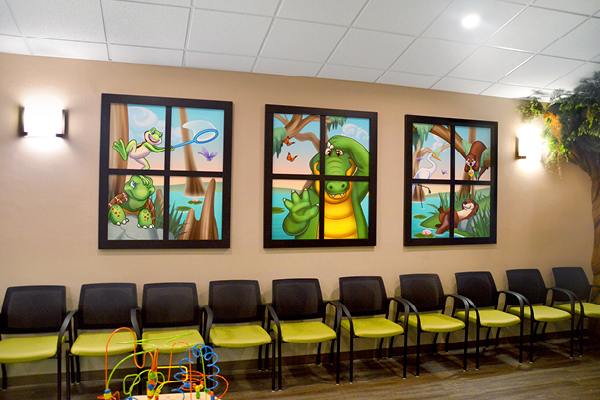
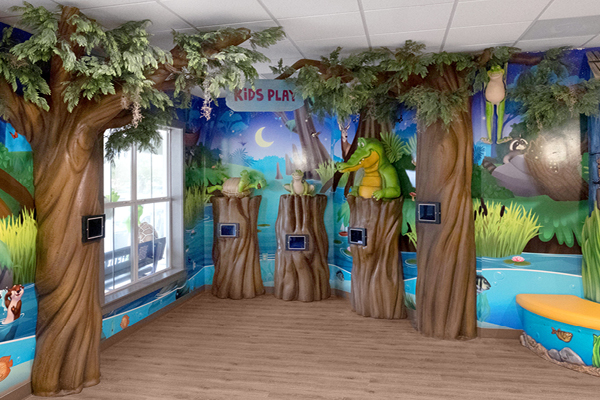
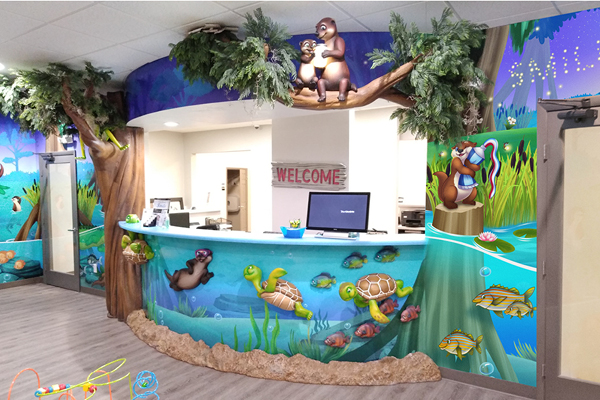
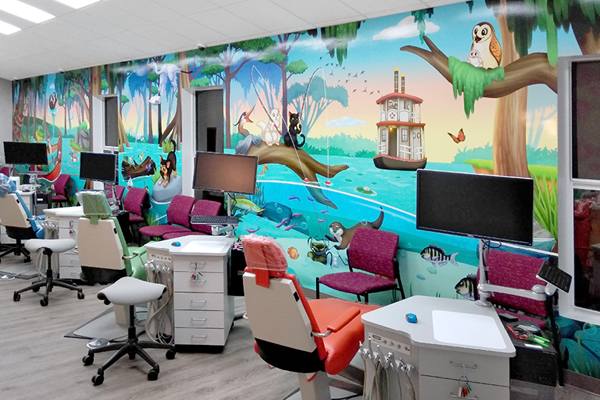
Dr. Martin: Gainesville is in a town where we have the University of Florida, and the mascot for the University of Florida is the Florida Gator. And of course, around here we have Bayou’s, but the theme went very nicely with everybody in town being a gator fan.
Do you think the theming has helped your practice?
Dr. Martin: Incredibly so. I think that it established our brand, people talk about it, and the word is out. It has created an incredibly fun place for kids to come.
Do you think that patients are more relaxed when entering your practice after it has been themed?
Dr. Martin: Absolutely, if they were ever in any other kind of office, a doctor’s office, or anything else like that, there’s usually some anxiety. So they walk in here and it’s like a trip to Disney World.
How would you describe the reactions from the patients when they come into the office for the first time, and even after multiple visits?
Dr. Martin: I think that the first time, the eyes are big and it’s a wow experience. And even after they’ve been here many times they are discovering something new each visit with the different animals and murals. The murals were designed by IDS to have little things hidden, so every time they come in they are going to see something new and different.
Do you think that you are gaining new patients as a direct response to the theming?
Dr. Martin: There’s no question about it. I think undeniably this is one of the best marketing tools you could possibly have.
Do people mention seeing your exterior alligator outside when they drive by?
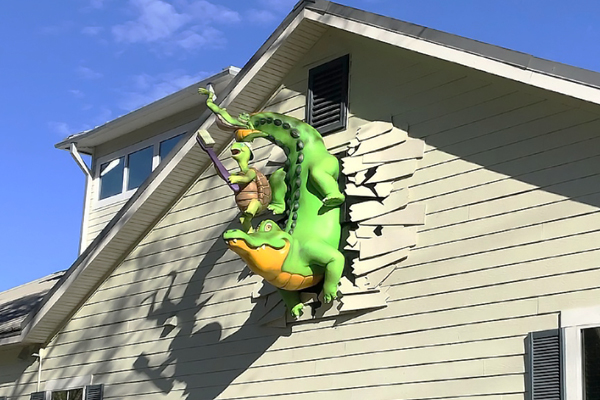
Dr. Martin: They do. When you go around town and you say “Hi, I’m Bill Martin, the Orthodontist at Martin Kids” the first thing they say is “Oh my gosh, that’s the alligator that comes out of the building.” We’ve since had people stopping by and taking pictures, it’s great.
In fact, they’ve said that anything out in this area they will tell their friends where it is in relation to the alligator coming out of the wall.
We also have a bench that has a couple of characters with a space in between them so the kids can get their picture taken there, and that’s being used all the time.
What do you think the staff’s response has been to the theming?
Dr. Martin: I think the staff is excited about it because it’s a fun thing. It’s a fun place to come, it’s a fun place for kids, and the funny thing is, that it’s also a great place for adults that never wanted to grow up.
How do you personally feel seeing the theming every day?
Dr. Martin: I love it, it puts a big smile on my face. In fact, instead of coming in the back door I come in through the front door now so I can see the theming of the different animals, and it makes me feel grand, it makes me feel happy.
Being that the theming is a few years old now, how do you think it has stood the test of time?
Dr. Martin: The quality is top-rate. It looks just like it did the day it was put in.
Can you tell any stories of children interacting with characters or spaces?
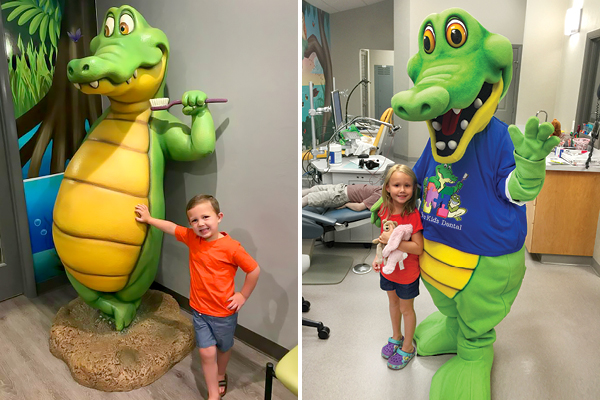
Dr. Martin: What you see out front is one of my favorite places, because the bench is set up so the kids can take pictures and they really like doing that. And then they will have a favorite character. So you can look behind me here, and some will get their picture taken with the alligator, and others with the frog and the turtle. It’s really a photo op moment.
What would you say that your favorite character or area is in the themed spaces?
Dr. Martin: My favorite character is Phineas Frog I call him, and he is the frog that has braces on him. Of course, being an orthodontist I am biased, but he’s a funny little guy.
What previous issues do you think that the office had that were solved through theming?
Dr. Martin: I think the theming makes the kids feel so much more relaxed, that is the big one. Plus it makes a statement to parents, that we have invested in their child’s well-being, and happiness and we are more than just putting our face in some kid’s mouth. So I think it really makes a statement to parents that we really care about your kid.
Would you consider adding more theming to other areas in the future?
I don’t see how you can make it any better, I think this was so thought out by the people at IDS that I just don’t know how I could improve it.
If you were to expand to other offices would you consider adding the theme installation to those offices as well?
Dr. Martin: Without a question. At first, when I got into this I said to myself “wow this is a lot of money” but when I look at the benefits of it, not only as a marketing tool, but it really is a marketing tool because you don’t have to put up a billboard when you have an office like this.
Do you think the theming goes hand in hand with your marketing and how do you feel that it is utilized in your marketing?
Dr. Martin: Absolutely, for sure it does.
What we do is we have the characters, and we of course use them when we film advertisements. The other thing is the alligator was so popular, that we had a company make a mascot like you see in the NFL or NBA, and when we go out to do public events, which we do a lot of, we always have our mascot with us. So that presents our brand, and the mascot is amazingly popular, the kids chase him around and hug him all day long.
What do you think are the most important benefits of the theming?
Dr. Martin: One is that it’s a great marketing tool and it certainly cuts down on a lot of the other marketing we would otherwise be trying to do. Two, it’s great for the kids, when they walk in the office they have a place where they walk in and go wow, this is really like going to a theme park. And three, quite frankly for us as a staff, it’s my happy place. When I come in in the morning I might not have a smile on my face, but after seeing these characters and looking at the murals, I got a smile.
How was your experience with IDS?
Dr. Martin: They were fabulous. They are an amazingly creative group, really worked within a budget for me as that was of course a big concern, and they put out a plan and if I said “wow that’s just way out of my budget” then they would modify it and I was always happy with every modification that they made. The guys in charge give me their cell phones. If I need to get in touch with them, they are available.
Would you recommend IDS to others in the future?
Dr. Martin: Absolutely. Nobody in my town, haha, but absolutely to anybody.
Starting with a passion to help others, founder Dr. Bill Martin opened the doors of his first practice in 1979. Since then, his vision has blossomed into a true family practice as his team of experts expanded to his two sons Dr. Dave and Dr. Paul.
Contact Imagination Design Studios (IDS) to get started transforming your office from a mundane to magical patient experience. Or download our inspiring look book and start imagining the possibilities in your office.
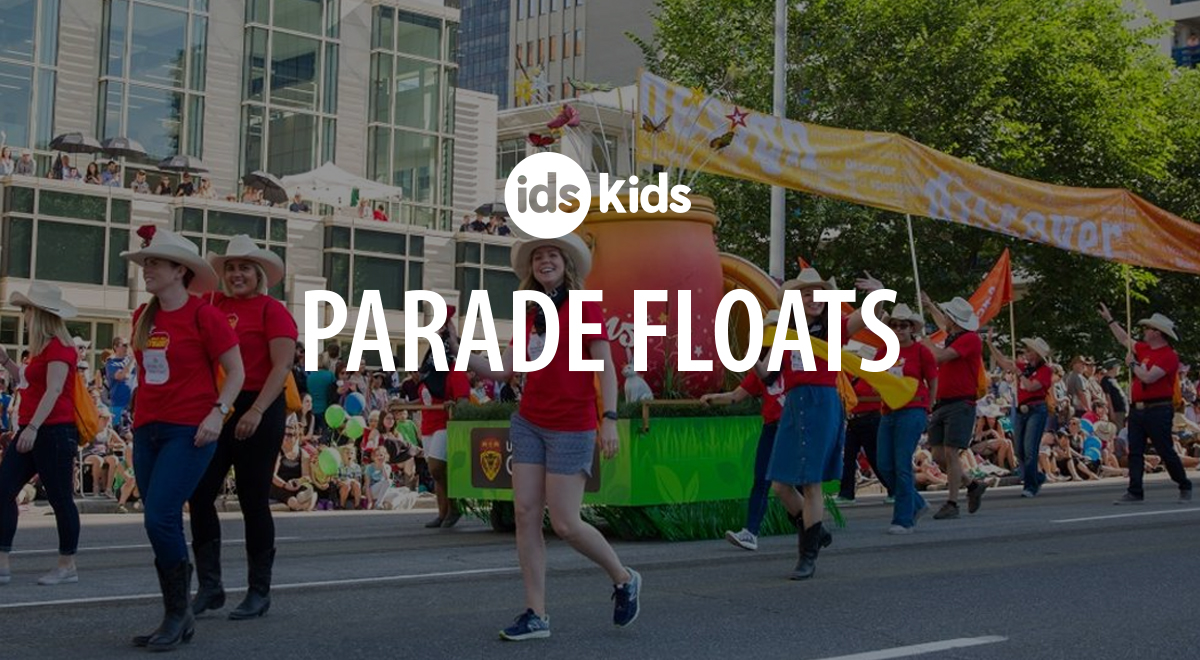
Parades have long been a cherished part of celebrations and cultural events worldwide. They evoke a sense of excitement, bringing communities together to celebrate special occasions and traditions. At the heart of these parades are the captivating parade floats, which not only add a touch of grandeur but also tell stories, promote businesses, and entertain the crowd.
In this blog post, we’ll explore the various types of parade floats and dive into the many benefits they bring to parades of all kinds.
Types of Parade Floats
Push Floats (or Manually-Powered Floats):
Push floats are typically moved manually by a group of people who push or pull the float along the parade route. These floats are a cost-effective option since they don’t require a vehicle for propulsion.
Car-Driven Floats:
Car-driven floats are built on a vehicle chassis, such as a truck or trailer, which provides the power and mobility needed to move the float. The vehicle is often concealed within the float’s design. Car-driven floats are versatile and can accommodate larger and more elaborate designs. They can also move at a consistent speed, allowing for precise synchronization with performances or other elements of the parade.
Towed Floats:
Towed floats are not equipped with their own built-in propulsion systems like engines or motors. Instead, they are towed or pulled along the parade route by a separate towing vehicle, such as a truck or tractor. These types of floats can be quite large, built on a flatbed trailer or other platform.
Floats with Performers:
Floats that host live performers, such as dancers, musicians, or actors, offer a dynamic and interactive element to the parade. These floats not only engage the audience but also elevate the entertainment factor, turning the parade into a spectacular show. They include specialty safety equipment or seatbelts to secure people to the platform.
The Benefits of Parade Floats
Visual Impact: Parade floats have an undeniable visual impact. Their vibrant colors, impressive designs, and thematic elements capture the audience’s attention, making them a memorable part of any parade.
Storytelling: Floats are powerful storytellers. They convey stories, cultural heritage, and brand messages effectively, creating a connection with the audience.
Community Engagement: Parade floats provide opportunities for community involvement. They foster a sense of unity and pride as individuals and groups come together to create and showcase their floats.
Advertising and Promotion: For businesses and organizations, parade floats serve as effective marketing tools. They reach a wider audience and promote products, services, or causes in a fun and engaging way.
Entertainment Value: Above all, parade floats contribute to the overall entertainment of the parade. Their creativity, performances, and captivating presence add to the festive atmosphere, ensuring that everyone has a good time.
We recieved a million likes both here and internationally from our social posts promoting our parade float. Unbelievable!
– Leader feedback from the Nigerian Canadian Association of Calgary
Tips for Creating a Successful Parade Float
Planning and Theme Selection: Choose a compelling theme that resonates with your audience and your brand.
Budgeting and Resource Management: Consider your budget and explore cost-effective ways to source materials and support for your float project. Allocating marketing budgets and fundraising can go a long way to making your float a reality.
Design and Construction: Find an experienced company that can guide you through the build process – Imagination Design Studios has been building floats for 30 years!
Safety and Regulations: Adhere to safety guidelines and parade regulations to ensure the well-being of participants and spectators.
Promotion and Participation: Promote your participation in the parade and engage the community to make your float a memorable part of the event. Get your float all over social media! Show off the build process and build momentum.
Parade Floats Are Great for Business
Parade floats are the heart and soul of parades, adding enchantment, storytelling, and entertainment to these celebratory events. Floats play a vital role in creating memorable experiences for communities around the world.
So next time you attend a parade, take a moment to appreciate the magic and creativity that parade floats bring to the festivities.
Want some more inspiration for promoting your town or business?
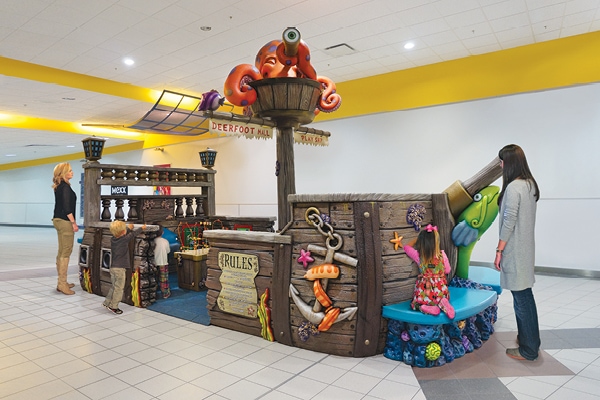
Indoor children’s play areas have become a popular addition to a range of family-friendly businesses in recent years. From shopping malls and family restaurants to gyms and fitness centers, airport waiting areas, hotels and resorts, rec centers, libraries, and more, indoor play areas offer a valuable service for families looking to keep their children entertained and engaged. These centers provide a safe and stimulating environment where children can play, learn and socialize, while parents can relax, catch up on work, or simply enjoy some downtime.
Indoor play centers offer an excellent business opportunity for entrepreneurs who are passionate about providing much-needed service to families in their community while generating profit. By offering a fun and safe space for families to enjoy, indoor play centers can enhance the overall experience of their host business and create a loyal customer base.
5 tips for creating the perfect family indoor play area for any size of space or type of business.
1. Plan the Size of Your Play Room Space
Determine the amount of space you have available and how you want to divide it up. Consider including separate zones for different age groups, such as a toddler area and a separate section for older kids.
A play area could be located in a small room off of your main business area, such as in a gym or community center, or in the center of a food court in a larger business like a mall or airport. Let’s look at some examples of what this might look like.
Play Rooms
Playrooms can make great use of vacant store space in a retail location.
Stand-alone Play Areas
Stand-alone play centers are self-contained. Great for hallways or wide open spaces.
Small Play Structures
A smaller fort may be all you need for the space you have available, but it will inspire big imaginations all the same.
Rec Center Play Room
2. Safety First for Children in Your Play Area
Once you have a space, safety should be a top priority when designing an indoor play area.
One of the most important aspects of creating a safe indoor play area is selecting the right type of flooring. Soft and cushioned flooring is ideal, as it provides a soft landing surface for children who may trip or fall during play. This type of flooring helps to reduce the impact of falls, minimizing the risk of serious injury.
In addition to selecting the right type of flooring, installing safety gates can also help to prevent accidents and injuries. Safety gates can be used to restrict access to certain areas of the play area to different age groups, such as keeping toddlers out of areas meant for older children.
Using age-appropriate toys and equipment is another important consideration when designing an indoor play area. Toys and equipment that are designed for older children may not be safe for toddlers and can increase the risk of accidents and injuries. Make sure to carefully consider the age range of the children who will be using the play area, and choose toys and equipment that are appropriate for their developmental level. We’ll get into more detail about the types of equipment in a moment.
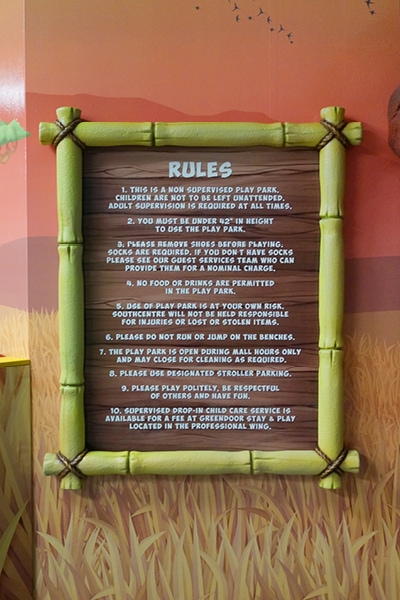
Don’t Forget the Rules
A list of rules for parents and children to follow will also help maintain safety.
Your play area rules could include:
Parental Supervision: Children must be supervised by a parent or guardian at all times while in the play area.
Age Limits: Clearly state age limits for different areas or equipment within the play area to ensure that younger children are not playing on equipment designed for older children.
No Roughhousing: Running, pushing, and other rough play should be prohibited to prevent injuries to children and damage to equipment.
No Food or Drinks: Eating and drinking should not be allowed in the play area to prevent spills and potential choking hazards.
No Shoes: Shoes should be removed before entering the play area to prevent dirt and debris from being tracked in and to reduce the risk of slipping and falling.
No Sick Children: Children who are sick or have a contagious illness should not be allowed to use the play area to prevent the spread of germs to other children.
No Bullying or Harassment: Bullying or harassment of other children should not be tolerated and will result in immediate removal from the play area.
Clean Up: Children should be encouraged to clean up after themselves and return any toys or equipment to their proper place after use.
3. Choose the Perfect Theme for Your Indoor Play Area
Having a theme helps create a cohesive and professional look to your play area, plus it is great for branding and advertising.
Your theme can be based on fun colors. It can be an out-of-this-world space or fantasy adventure. If you’re located in a coastal mountain town or a desert city, you can use your local flora and fauna to inspire you.
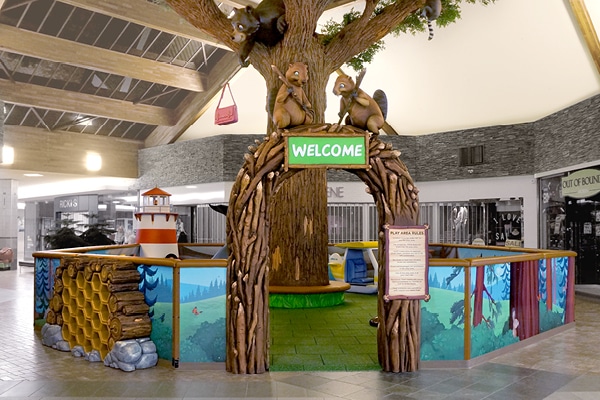
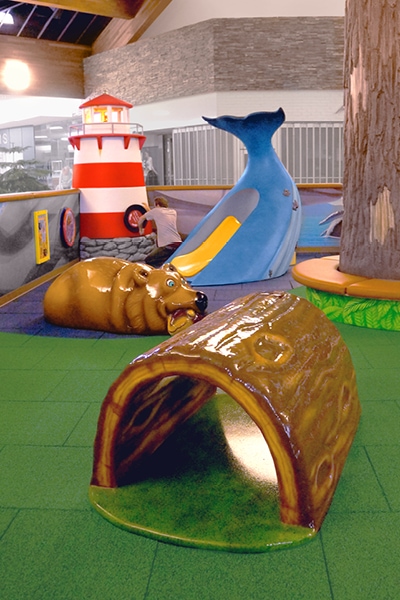
For example, the Westshore Town Centre shopping mall takes its name to heart, with a selection of shoreline-themed play structures including a climbable soft play bear catching a salmon, a whale tail slide, a lighthouse with a wheel that spins the light, plus so much more. This centerpiece play area reflects the brand of the mall along with the local landmarks guests are familiar with.
4. Select a Variety of Age-Appropriate Activities for Your Play Area
Select activities that are suitable for the ages of the children who will be using the play area. For example, a toddler area could include soft play mats, low-height slides, and ride-on toys, while an older kids’ zone could include climbing walls, ball pits, and interactive video games.
Hands-on Play Options
Hands-on play is great for younger kids as it helps develop fine and gross motor skills, hand-eye coordination, spatial awareness, and social skills as children interact with others. Hands-on play options could include Keebee playboards, sensory tables like bead maze tables or magnetic activity tables, large puzzles, building blocks, and coloring areas with markers and crayons.
Woodland rock game wall with Keebee play boards for toddlers.
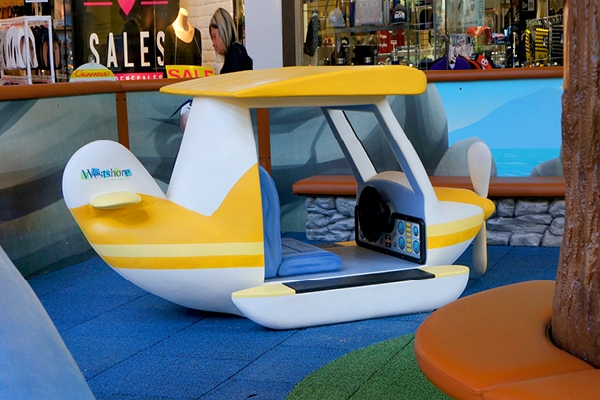
A seaplane that allows kids to turn the wheel and use their imagination.
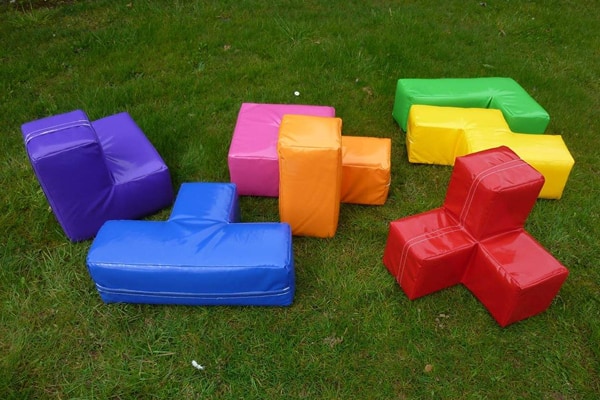
Giant foam play blocks.
Interactive play inspires imagination!
Soft Play Climbable Sculptures
“Soft play” sculptures are typically made from high-density foam that is covered with a durable, waterproof vinyl material. This makes them safe for children to crawl on, climb over, and play with, while also being easy to clean and maintain.
Soft play sculptures come in a variety of shapes and sizes, including characters, slides, tunnels, vehicles, and more. They can be customized to fit any theme or color scheme, making them a popular choice for indoor play areas, daycare centers, and other children’s facilities.
Soft play foam sculpture slide with a goat sitting on a mountainside.
Because soft play sculptures are soft and squishy, they are less likely to cause injury than traditional play equipment made from hard materials like metal or plastic. They can also be used to create obstacle courses and other interactive play experiences that promote physical activity and imaginative play.
A mall play area filled with soft play sculptures for children to interact with.
Slides
Slides are a popular and fun form of active play for children of all ages, and even adults can enjoy them. Sliding down a slide can provide a sense of thrill and excitement, as well as help to develop physical skills such as balance, coordination, and gross motor skills. And they’re just plain fun!
Ball Pits
Playing in a ball pit provides a tactile and sensory-rich experience, which can be beneficial for children with sensory processing difficulties. The feeling of sinking into a pit filled with soft, squishy balls can be calming and regulating. Let’s not forget that a ball pit is simply a fun and enjoyable experience for children. It can provide a break from structured activities and offer a chance to dive in and laugh to their heart’s content.
Climbing Structures and Ropes
If your facility has the capability and space to incorporate climbing structures, tunnels, and rope courses, these can offer an exciting and engaging way for children to develop essential gross motor skills such as coordination, balance, and strength. Not only do climbing structures provide a safe environment for children to take risks and explore their limits, but they also foster the development of confidence and self-esteem as they navigate through the structures under supervision.
As technology continues to play an increasingly important role in daily life, offering video games in a play area can provide children with a chance to become familiar with and comfortable using technology in a safe and supervised setting. Many video games require players to use hand-eye coordination and problem-solving skills, which can help develop these skills in children.
Offering video games alongside other play options like climbing structures, ball pits, and sports activities can provide a generous range of play activities for children and keep them entertained for longer periods.
If you want the best of both worlds, a great alternative is floor-projected video games. These games encourage active participation by inviting children to jump and stomp on animated bugs, balls, and lily pads that are projected onto the floor.
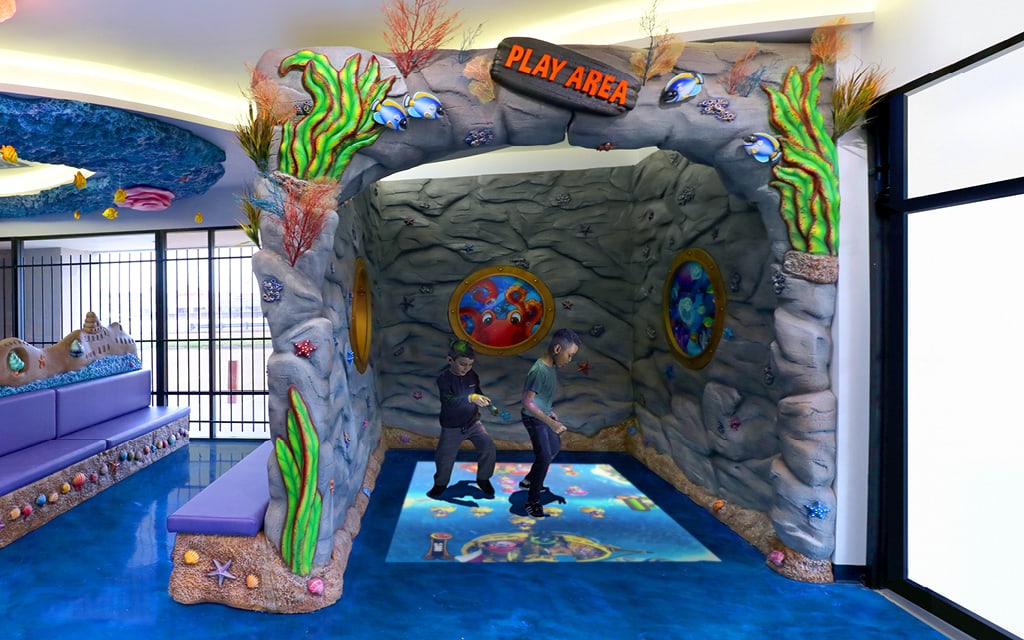
An underwater themed play area featuring a floor-projected video game for kids.
TVs and Theaters
While adding a TV to a play area can provide entertainment for children, it may not offer the same developmental benefits as active play options. However, it could be a viable addition to a play area depending on the needs of the business and the interests of the children. If children are tired from play but not ready to leave yet, it provides a quiet alternative for those taking a break.
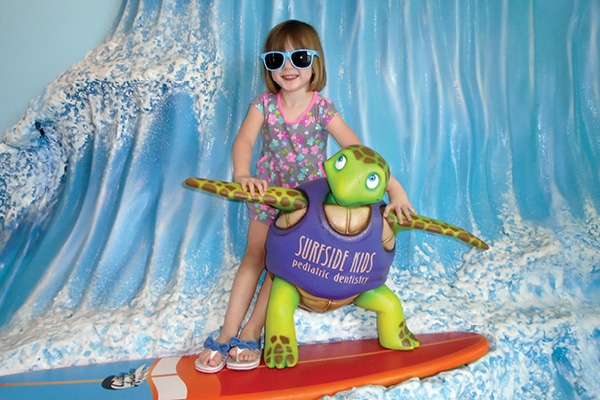
Photo Op Characters and Backdrops
Parents are all about capturing fun and special moments with their children as they play. Providing the perfect photo opportunity for them is a bonus for parents and an even bigger bonus for your social media.
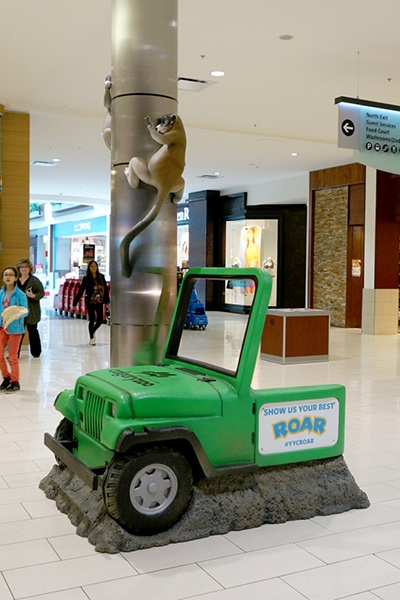
Parents who take and share photos of a fun day at your play park are creating valuable user-generated content that helps promote your fun services. Include your name, your logo, or even encourage the use of a hashtag to make the best use of this content.
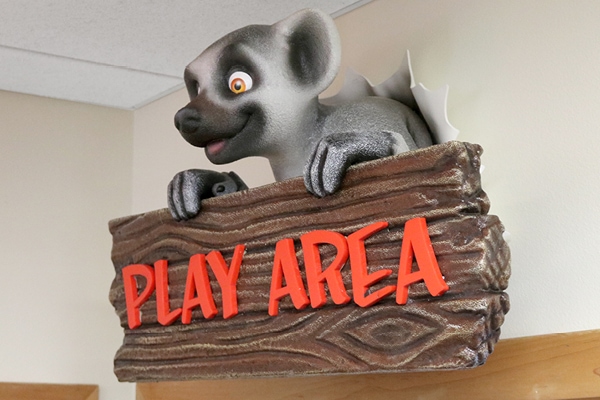
Signs can also include your logo, hours of operation, and other useful information, like where the bathroom is located.
Keep it All Clean with a Shoe Rack
Adding a shoe rack outside your children’s play area can have several benefits:
Keeping the play area clean: Children can bring dirt, mud, or other debris on their shoes when they enter the play area. By having a shoe rack outside the play area, you can encourage them to take off their shoes and leave them outside, which can help keep the play area clean and safe for children.
Preventing slips and falls: Wet or muddy shoes can make the floor slippery, which can increase the risk of slips and falls. By leaving shoes outside, you can prevent these accidents from happening and keep your children safe.
Encouraging organization: A shoe rack outside the play area can encourage children to take responsibility for their belongings and keep them organized. It can also make it easier for them to find their shoes when they need them.
Provide Comfortable Seating for Parents
Make sure to include comfortable seating for parents or caregivers to relax while the children play. Consider adding tables and chairs for snacks or drinks. If food is not allowed near the play area, consider adding a seating area nearby where the play area can still be observed.
Providing seating areas can create a social atmosphere for parents and caregivers to interact with one another. This can lead to new friendships and a sense of community.
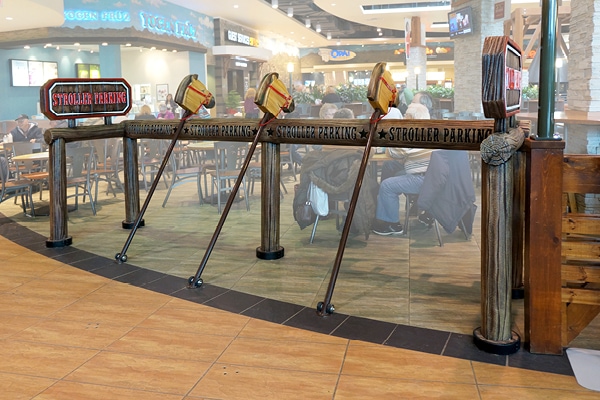
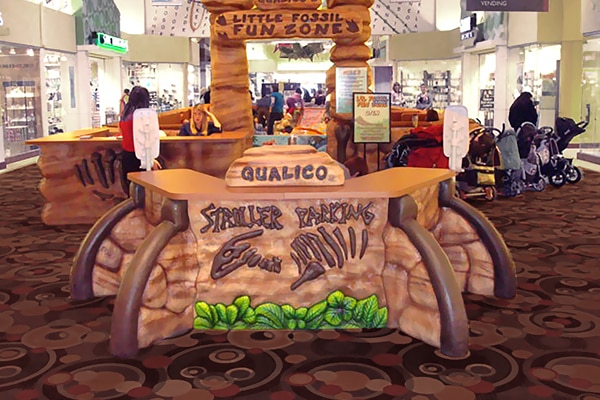
Plan for Stroller Parking
Families with children of all ages will want to come to your play area. Make it as convenient as possible for them by providing a space for them to store their bulky strollers.
Providing a designated space for stroller storage can help eliminate any potential hazards or clutter that may disrupt the play area. Having a safe and easily accessible place to store strollers also makes it more convenient for families with young children, as they won’t have to worry about maneuvering a bulky stroller through a crowded play area.
Follow This Guide to Create the Perfect Indoor Family Play Area
The benefits these play areas can offer parents and kids alike make them invaluable. Now that you have this information in mind, why not consider creating one at your own location? With this list you should be on your way to making an amazing play area for children in any business or location. So don’t hesitate, let the kids go play!
Don’t know where to start with creating your indoor playground? One of our Creative Consultants would love to help. Contact Imagination Design Studios (IDS) to get started transforming your facility from a mundane to a magical guest experience.